Writing a CV When You're Starting Out: A Complete Guide
Your CV is an advert for you. That's it. Its only job is to convince someone to invite you for an interview. It doesn't need to be perfect, it doesn't need to follow rigid rules, and it definitely doesn't need to be long. It needs to work.
If you've never written one before - or you've written one and it's not getting results - this guide walks you through the whole process from scratch.
Part 1: Understanding what a CV is for
A CV (curriculum vitae) is a short document that summarises who you are, what you can do, and why an employer should want to meet you.
That's the textbook answer. The more useful one is this: your CV is the only way most employers can decide whether you're worth interviewing. It's usually the first thing they see, and often the only thing they see before making a yes/no decision. So it needs to sell you - clearly, quickly, and honestly.
There are no hard-and-fast rules about how a CV should look. If it's regularly getting you interviews, it's working. If you're applying for the right roles and not getting interviews, it isn't. Whether you followed someone else's "rules" is irrelevant.
When to use a CV:
- When a job ad asks for one
- When an ad says "apply in writing"
- To take to careers fairs and recruitment events
- When approaching employers speculatively
- As a reference when filling in application forms
When NOT to use a CV:
- When a company provides an application form - they want you to use it, not substitute a CV
- Online application systems that ask you to fill in fields (use the CV as a reference while you complete their form)
How employers actually read your CV
Before you start writing, it helps to understand what happens on the other end. Most people never think about this, and it shows in their CVs.
Imagine you're hiring someone. You might have three or four CVs on your desk, in which case you can read each one carefully, think about each person, and make a considered decision.
Now imagine you have a stack of 200 CVs and a busy day ahead. Each of those CVs is going to get seconds of attention. Research suggests recruiters spend an average of 30 seconds on an initial scan - and if the first half-page doesn't seem relevant, it goes straight in the reject pile.
You also can't assume who's reading it. In a small company, it might be the owner. In a large company, it could be an HR assistant who doesn't know your field. If you're applying for a technical role, don't assume the first reader is technical - explain and sell what you've done, don't just list it and hope it speaks for itself.
This means two things:
- Don't hold anything back. People sometimes think "I'll save this for the interview." If you hold it back, you might not get the interview.
- Put the best stuff at the front. The most relevant information needs to be visible within seconds. Bury it on page two and it might never be read.
Part 2: Preparing to write
The biggest mistake people make is opening a blank document and trying to write their CV from scratch. Don't. Prepare first. Most people hate writing their CV because they try to think and write at the same time - separating those steps makes the whole thing easier.
Step 1: Do a complete skills audit
Dig out anything that might help you remember what you've done - old CVs, application forms, school reports, certificates, references, job descriptions. Then get a piece of paper and write down everything you've ever done that could possibly be relevant to an employer. Everything. Don't edit yourself yet - this is a brain-dump, not a finished document. Nobody will see it except you.
- Education - schools, colleges, courses, results (don't worry about formatting)
- Any work at all - paid jobs, Saturday jobs, babysitting, helping in a family business, paper rounds, temp work
- Volunteering - charity shops, community groups, sports clubs, helping at school events, fundraising
- Skills - IT skills, languages, driving licence, first aid, anything you've learned formally or informally
- Achievements - Duke of Edinburgh, sports awards, prefect/head boy/girl, any prizes or competitions
- Responsibilities - group leader at a youth club, school representative, committee member, anything where someone trusted you with a role
- Interests - but only ones that tell an employer something useful about you
- Things you've taught yourself - online courses, self-study, skills picked up at home or on the job
Go through these one by one and really think. One memory will spark another. You might end up deleting 90% of it - that doesn't matter. There will be something in the 10% you keep that you'd never have remembered otherwise. Ask other people too - friends, family, teachers. They often see strengths in you that you take for granted.
Step 2: Think about what the employer wants
Before you start assembling your CV, look at the job you're applying for. What does it actually ask for? Usually it's a combination of:
- Skills - specific things you can do (use a till, drive a car, use Excel)
- Qualities - how you work (reliable, good communicator, team player, organised)
- Experience - what you've done before (and this is where most entry-level candidates panic)
Here's the thing about experience: you have more than you think. Employers at entry level know you haven't had a career. What they're looking for is evidence that you can turn up, work with other people, learn new things, and be trusted. You can demonstrate all of that without having had a "proper job."
Running a household, looking after children or elderly relatives, organising a school event, serving customers in a shop on Saturdays, helping coach a sports team - all of this counts. The skill is in presenting it the right way.
Step 3: Match what you have to what they want
Here's an exercise that really helps. Find a dozen or so job adverts for the kind of roles you're interested in. Go through each one and highlight every keyword and key phrase - things like "must be passionate about helping others", "excellent communication skills", "will be required to manage customer relationships."
Collect all these keywords in one place and group them. Then compare that list to your skills audit:
- Things on both lists but in different words - this is gold. If they say "customer service" and you wrote "helping people in the shop," change your wording to match theirs. Don't make employers guess.
- Things employers ask for that you forgot to include - add them now.
- Things you thought were important but no employer mentions - lower priority if you're short on space.
This matching exercise gives you the language and priorities to write a CV that speaks directly to what employers are looking for.
Part 3: Choosing your format
Most CVs follow what's called a reverse chronological format - you list your most recent experience first and work backwards. This is the most common approach, it's what most employers expect, and it's what we'd recommend for most people.
But if your work history doesn't tell a straightforward story - you've changed sectors, have significant gaps, or your most relevant experience isn't your most recent - a skills-based (or functional) CV might work better. This format leads with a skills section grouped by theme (e.g. "Customer Service", "Administration", "Project Management"), supported with examples drawn from across your history. Your employment history still appears, but shorter and less prominent.
When to use a chronological CV:
- You have a clear, logical career progression
- Your most recent experience is the most relevant
- You're staying in the same sector
When to use a skills-based CV:
- You're changing careers and want to highlight transferable skills
- You have gaps in your employment history
- Your relevant experience is scattered across different roles and time periods
For most entry-level candidates, a chronological CV works fine. If in doubt, stick with chronological.
Part 4: Writing each section
Contact details
Put your name, phone number, email address, and the town/city you live in. That's it.
Don't include: your full postal address, your date of birth, your marital status, your nationality, or a photo. None of these are expected in the UK and some can lead to unconscious bias.
Here's the difference:
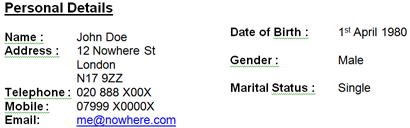
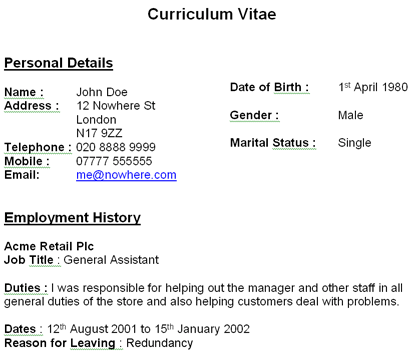
Too much - date of birth, gender, and marital status are irrelevant and waste space.

Much better - name, address line, phone, and email. That's all an employer needs.
Do make sure: your email address is professional. firstname.lastname@gmail.com is fine. partyanimal99@hotmail.com is not. And check that the email account actually works - you'd be amazed how many people put an address they never check.
You don't need to write "CV" or "Curriculum Vitae" at the top. Everyone knows what it is. You also don't need to label each field - "Name:", "Address:", "Phone:" - it's obvious from context and wastes space.
Personal statement (2-3 sentences)
A short paragraph at the top that says who you are, what you're looking for, and what you bring. This is the first thing an employer reads after your name, so make it count.
This is also the hardest part of your CV to write. A useful trick: write it last. Finish all the other sections first, then come back and write the introduction. By that point you'll have a much clearer sense of what you're selling.
For someone with no work experience:
A motivated school leaver with strong communication and organisational skills developed through volunteer work at [organisation] and part-time work at [place]. Looking for an entry-level role in [sector/type] where I can learn and contribute while building a career.
For a career changer:
An experienced professional looking to transition into [sector]. Bringing strong transferable skills in [communication/organisation/problem-solving/customer service] developed over [X] years in [previous sector], along with a genuine interest in [new sector].
For someone returning to work:
Returning to the workplace after [a career break / time spent as a full-time carer]. Organised, reliable, and experienced in [relevant skills - managing household, coordinating schedules, volunteering]. Looking for a [part-time/full-time] role in [sector/type].
Keep it genuine. Employers can spot a template a mile off - adapt these examples, don't copy them word for word.
Education and qualifications
List your most recent education first. For each entry, include:
- Name of school/college/university
- Dates attended
- Qualifications gained
- Any relevant coursework, projects, or final pieces of work worth highlighting
How much detail? That depends on how recent it is. If you're a school leaver, list each qualification and your grades - they're your main selling point. If you left education 20 years ago, nobody needs to know whether you got a B or a D in Geography GCSE.
A note on grades: it's fine to list qualifications without mentioning grades at all. Don't lie about them, but omitting them is perfectly acceptable. Just be consistent - if you include grades for some and not others, it's obvious you're hiding something.
If the job requires specific training, explain what it means. Don't just write "NVQ Level 2 Hospitality" - say what it covered. Relate your education to the workplace where possible: not "Advanced Excel" but "Creating and managing data reports using Excel."
If you left school without many qualifications, don't worry. List what you do have and make the other sections stronger.
Example - education section for a school leaver:
Westfield Academy, Birmingham - Sept 2022 to June 2024 GCSEs: English Language (6), Maths (5), Science (5-5), Business Studies (6), Geography (4), Art (7)
Relevant coursework: Business Studies controlled assessment on local marketing strategies - received highest mark in year group.
Example - education section for someone with vocational training:
City College, Leeds - Sept 2023 to June 2024 Level 2 Diploma in Health and Social Care - Distinction Covered safeguarding, communication in care settings, personal development, and equality and diversity. Included 100 hours of supervised placement at a residential care home.
Work experience
List any work you've done, most recent first. For each role, include:
- Job title
- Employer name
- Dates (month/year to month/year)
- 2-3 bullet points describing what you did - focus on what you achieved, not just what you were responsible for
If you have no paid work experience, use a section called "Experience" instead and include volunteering, work placements, and any other relevant activity.
The key is to be specific and measurable. Vague descriptions don't sell you. Compare:
Weak: "Helped in charity shop"
Strong: "Served customers, handled cash, and organised stock displays at [charity]. Worked independently during busy periods and trained two new volunteers."
Weak: "Did work experience at an office"
Strong: "Completed a two-week placement at [company], supporting the admin team with filing, data entry, and answering phones. Received positive feedback on reliability and attention to detail."
Weak: "Worked to sales targets"
Strong: "Met or exceeded monthly sales targets for 10 consecutive months, consistently ranking in the top 3 of a team of 12."
The pattern: what you did, how much, how well. Numbers and specifics make your experience real.
If you've had lots of short-term jobs, group them. Rather than listing four separate three-month admin roles, list "Administrative Temp Work - 18 months" and mention specific clients underneath. This looks much better than a string of very short entries.
Here's the difference good formatting makes:
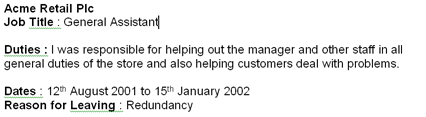
The job title is buried, the description is vague, and "Reason for Leaving" wastes valuable space.
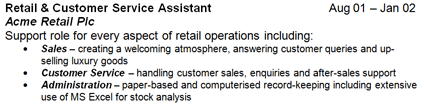
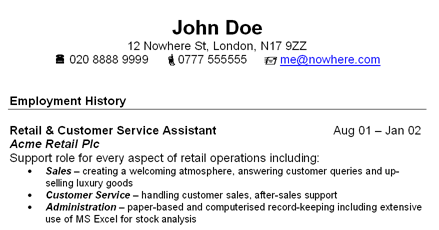
Job title and company jump out immediately. Bullet points highlight specific, relevant achievements. Dates are clear but not dominant.
If you've been in one organisation but in different roles, show the progression. List the company once, then each role as a sub-entry with its own dates and bullet points. This highlights career growth rather than making it look like one static job.
Skills
A short section listing specific, provable skills:
- IT skills (name the software: Word, Excel, Google Workspace - and be specific about your level: "5+ years using Excel including pivot tables and VLOOKUP" is much stronger than "Good IT skills")
- Languages (specify how well - conversational, fluent, business-level, spoken and/or written)
- Driving licence
- First aid or health and safety certificates
- Any sector-specific skills or certifications
Don't list "communication" or "teamwork" as standalone skills - these are qualities, and they belong in your personal statement or woven into your experience descriptions. Any skill you claim here should be backed up elsewhere in your CV. If you say you have project management skills, your experience section needs to show where you used them.
Interests (optional)
Only include interests if they tell the employer something useful. "Reading, socialising, and keeping fit" tells them nothing - it describes most of the population.
Good interests show commitment, skill, or character:
- "I run a weekly five-a-side league for 20 players" - shows organisation
- "I maintain a personal blog about cooking" - shows writing skills and initiative
- "I volunteer as a football coach for under-12s" - shows reliability and working with people
If your interests are genuinely "watching TV and seeing friends," just leave this section out. That's fine. An empty space is better than filler that adds nothing.
One thing to watch: think about what your interests say to an employer. "I love to travel and want to see the whole world in the next five years" is enthusiastic and interesting - but what does it say to someone looking for a long-term hire?
Part 5: Making it work
Length
Two pages maximum. For most entry-level candidates, one page is often enough and that's perfectly fine. An employer would rather read one strong page than wade through two pages of padding.
If your first draft is five or six pages, don't panic. A lot of it will be repetitive or contain too much detail. Some techniques for cutting it down:
- Short sentences beat long ones. "I outperformed my sales targets every month" is far better than a rambling paragraph about team targets and where you ranked.
- Bullet points replace paragraphs. You can often condense a whole paragraph into two or three clean bullets that take up less space.
- Use it or lose it. If a sentence isn't selling you, cut it. If three similar roles repeat the same skills, say it once.
- Adjust margins and font size if you're just a few lines over - but don't shrink things so far that it becomes hard to read.
Layout and formatting
To see why layout matters, look at these two CVs side by side - first blurred, the way an employer scanning a pile would see them:
Even blurred, you can see which one has clear structure and which is a wall of text. The one on the left has visible headings, clear spacing, and a professional layout. The one on the right starts with "Curriculum Vitae" (wasted space), uses a cluttered table for contact details, and has no visual hierarchy.
And here they are clearly:
The practical rules:
- Use a clean, readable font (Calibri, Arial, or similar - not Comic Sans, not anything fancy)
- Font size 11-12 for body text, slightly larger for headings
- Clear section headings so someone can scan quickly
- Consistent formatting throughout (if you bold one job title, bold them all)
- Plenty of white space - a cramped CV is hard to read
- Don't let a section break across two pages - either fit it on the first page or start it on the second
Think about what jumps off the page when someone skim-reads. Your name, your job titles, your key skills - these should be the things that catch the eye, not labels like "Name:" and "Address:" that waste visual prominence on the obvious.
ATS: the thing most people don't know about
Many larger employers use Applicant Tracking Systems (ATS) - software that scans your CV before any human sees it. Around 75% of UK employers now use some form of hiring technology to filter applications. The software looks for keywords that match the job description, and if your CV doesn't contain them, it may never reach a human reader.
What this means for you:
- Use standard section headings ("Work Experience", "Education", "Skills" - not creative alternatives like "My Journey" or "What Makes Me Tick")
- Include keywords from the job ad naturally in your CV - if they ask for "customer service" skills, use those exact words
- Keep formatting simple - tables, columns, headers/footers, and graphics can confuse ATS software. Stick to a straightforward single-column layout
- Save as .docx or PDF unless the employer specifies otherwise
Tailoring - what it actually means
You'll hear people say "tailor your CV for each job." Good advice, but what does it actually mean? Not rewriting from scratch every time. It means:
- Adjust your personal statement to reflect the specific role and company. Two sentences is all it takes.
- Reorder your bullet points so the most relevant experience for this particular job comes first.
- Mirror the language of the job ad. If they say "stakeholder management" and your CV says "working with different people," change it. Don't make them guess that you can do what they're asking for - use their words.
- Emphasise different things. If you're applying for a customer-facing role, lead with your customer experience. If you're applying for an admin role, lead with your organisational skills. Same CV, different emphasis.
Five tailored applications will get better results than 50 identical ones.
Part 6: Handling tricky situations
What if you have gaps in your employment?
Gaps happen. Employers understand this - what concerns them is an unexplained gap, because they'll fill the silence with their own assumptions.
Briefly explain what you were doing. You don't need to go into detail - just enough to show the gap wasn't wasted:
- "Career break to raise a family (2019-2023). During this time, volunteered at [school/charity] and completed an online course in [subject]."
- "Extended travel across Southeast Asia (2022-2023). Developed language skills, managed budgets independently, and gained cross-cultural experience."
Think about what you learned during the gap. If you were raising a family, you were managing schedules, handling difficult situations, budgeting, and juggling competing demands - all real skills. If you were unemployed, did you do any courses, volunteer work, or personal projects? Get it on the CV.
A formatting trick: if your gaps are noticeable, consider putting dates on the right side of the page rather than the left. People read left to right, so this makes the dates slightly less prominent without hiding them.
What if you were fired?
You don't need to mention it on your CV. Your CV lists where you worked and what you did - not why you left. If asked at interview, be honest and brief: explain what happened, what you learned from it, and move on. Most employers care more about how you handle the question than the answer itself.
What if you have a criminal record?
You're not required to disclose spent convictions on a CV (the Rehabilitation of Offenders Act 1974 covers this, though some roles are exempt). If a conviction is spent, you don't need to mention it. If a role requires a DBS check, the employer will tell you - disclosure is handled separately from your CV.
What if you've been out of work due to illness or caring responsibilities?
Treat it the same as any other gap: explain briefly and positively. "Career break due to health reasons - now fully recovered and ready to return to work" is honest without oversharing. "Full-time carer for a family member (2020-2024)" is perfectly respectable and shows responsibility.
Part 7: Final checks
- Spelling and grammar errors - Studies consistently find that the majority of CVs contain at least one error, with some research putting it as high as two-thirds of all CVs submitted in the UK. Even one mistake can be enough to put your CV in the reject pile. The fix is in the next section.
- Including everything - Your CV is a highlight reel, not your autobiography. Cut anything that doesn't help your case.
- Unexplained gaps - If you've been out of work, briefly explain what you were doing. A gap with no explanation makes employers wonder.
- Using a generic CV for every application - At minimum, tweak your personal statement for each role.
- Lying - Don't. Exaggerate gently if you must, but outright lies get caught at interview or on the job, and you'll lose the role and your reputation.
- Including "References available on request" - Everyone knows that. It wastes space. When employers want references, they'll ask.
How to proofread properly
Your own eyes will skip over mistakes in your own writing. Your brain knows what you meant to write and fills in the gaps. So you need to break that pattern:
- Read it backwards. Start from the last sentence and read each sentence in isolation. This forces you to see what's actually written rather than what you think you wrote.
- Read it out loud. If a sentence sounds awkward when spoken, it'll read awkwardly too. This also catches missing words and clumsy phrasing.
- Print it out. People spot different errors on paper than on screen. If you've been staring at a screen for hours, printing it gives you fresh eyes.
- Get someone else to read it. Not someone who'll just say "it's fine" - someone who'll actually tell you if something doesn't make sense. A teacher, a careers adviser, or anyone who's done hiring. Their perspective is worth more than yours.
- Check your dates. Make sure they line up chronologically, there are no overlaps that don't make sense, and no accidental typos turning 2023 into 2032.
- Check it on different devices. Open the file on a phone or tablet as well as your computer. Formatting that looks fine on a laptop can break on a smaller screen, and some employers will read your CV on a mobile.
What next?
Your CV is a living document. Update it after every new experience, skill, or qualification. Every few months, read it fresh and ask: does this still represent me well?
If you're applying for jobs and not getting interviews, your CV is the first thing to revisit. Ask someone you trust to read it honestly - not someone who'll just say "it's fine." Ask a careers adviser, a teacher, or anyone who's done hiring. Their perspective is worth more than yours.
And remember - a CV that's not getting results doesn't mean there's something wrong with you. It might just mean the advert isn't quite right yet. Keep tweaking it, keep getting feedback, and keep going.